
Also in endourology: “AI has come to stay”
While increasingly sophisticated robots, urology training, imaging and screening may seem likely urological candidates for AI integration, on the third day of EAU26 in London it became clear that AI will also become integrated in endourology in the near future.
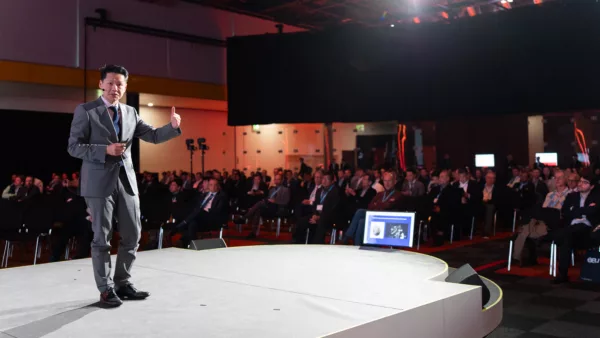
Prof. Ben Turney (GB) gave a state-of-the-art lecture on the prognostic and surgical applications of AI that directly impact endourology as part of the Plenary Session on Upper Tract Endourology. “As we all know, we are currently in a global AI boom, with applications already in widespread use. Whether you’re an optimist or a pessimist or a skeptic, it is already entering our field. Out of the total amount spent on AI development in the coming five years, 10 percent will be in healthcare,” Prof. Turney introduced the topic.
“Already today you can use medical scribes that summarise patient consults and give the patients a report of their conversation. You could use an avatar to answer your patients. Patients are already using AI in search engines or dedicated chat bots to look for information and they can come to your practice better informed.”
The four main categories when it comes to surgical applications are diagnosis, outcomes prediction, surgical planning and patient monitoring.
“Computer vision can enhance and analyse your imaging data in real time. It can map stones, so that even when you don’t have optimal vision, you can continue with your procedure. AI can also help combining imaging data, patient data, urine analysis and more to come up with a ’personalised stone’ approach.”
“Large language models can also adapt to cystoscopic image interpretation. This is all entering our sphere in the coming years. There might be booms and busts in AI, but within five years we will see wide integration into our ‘endourology world’,” Prof. Turney concluded.
Prof. Palle Osther (DK), a veteran in the stone scene and co-chair of the Plenary Session could only agree: “AI has come, and it has come to stay in endourology.”
More than 65 scope options
The endourology Plenary Session also featured case discussions comparing various treatment options for an asymptomatic stone patient: shockwave lithotripsy, flexible ureteroscopy and watchful waiting, showing that even when the medical solution seems straightforward (option 2) and the debate somewhat futile, presenting the benefits and drawbacks of each option, as well as taking into consideration the needs of the patient can be the deciding factor. The majority of the audience opted to keep an eye on the patient and not treat for as long as she wasn’t suffering.
Dr. Amelia Pietropaolo (GB) gave an overview of the huge variety of ureteroscopes that urologists could have at their disposal. She counted at least 65 options on the market at the moment, attempting to categorise and rank them in their most important differences. Single-use vs. reusable is an important option, the benefits and drawbacks of smaller scopes, the amount of flexibility, integrated suction, intrarenal pressure sensors, costs and sustainability are all matters to consider when picking an instrument.
The session ended with an introduction by Dr. Ben Chew (CA) of a new kind of shockwave treatment for stones: burst-wave lithotripsy. A portable machine, the Sonomotion is coming to the market, offering a non-invasive, anaesthesia-free way of disintegrating stones without the expense and scale of ESWL systems. This system is currently entering the market and may enter endoscopists’ armamentaria soon.