
An essential mythological companion for urologists: A Conversation with Stephen Fry
There was a buzz of anticipation in eURO Auditorium 2 today, the opening day of the 41st Annual EAU Congress in London, as the crowd awaited the arrival of Sir Stephen Fry (GB), in conversation with Mr. Ben Challacombe (GB). While the Annual Congress can often attract big names in urology, or for instance government ministers, it is rare for an international household name like Stephen Fry to make an appearance.
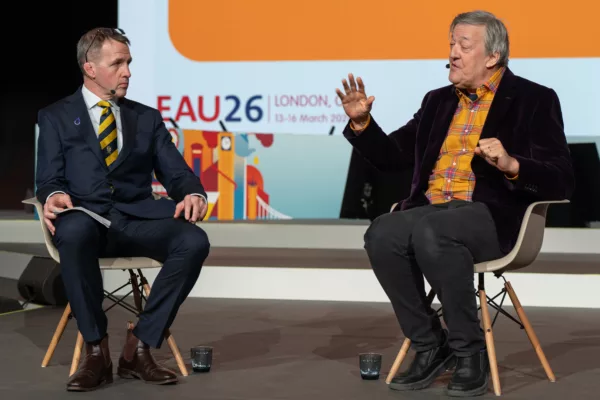
Making full use of the new stage set-up, the talk between Sir Stephen and Mr. Challacombe was spontaneous and intimate, and promised to cover “gods, genitals and the burden of being human” as an essential mythological companion. For half an hour, the audience was engaged by an exploration of ancient myth and the urological themes within it.
Creation and Fertility
The conversation started with Sir Stephen pointing out how fertility and ejaculation can be found in various “creation myths”, as ancient peoples tried to make sense of their existence, springtime, life and death. “In a sense, any force you cannot explain is a god,” he explained.
Phallic symbolism was also rife in ancient Greece, for instance in the story of the deity Uranus who was castrated by the Titan Cronus. The blood from that injury, hitting the soil also produced life: the Furies, Giants and Meliae.
Sir Stephen contrasted the Athenian ideal of the modest, restrained penis, as seen in many classical art forms, with the “preposterous, gigantic phallus” as seen in depictions of the fertility god Priapus (and well-known to urologists in the sense of “priapism”).
Ancient origins can also be found in urology terms like an ‘orchidectomy’ and even the association of cancer with crabs. Tumours or cancers were seen to clamp onto the human body, with pincers like a crab.
After Mr. Fry explained to Mr. Challacombe the difference between etymology and entomology (“the study of insects”), he pointed out that the subject of penises still makes us involuntarily laugh, even an audience which “handles penises every day”.
Background
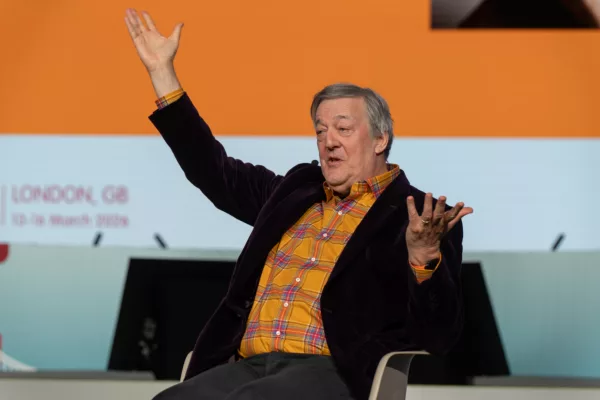
Sir Stephen Fry is a writer, broadcaster, actor and comedian. In 2018 he shared that he had undergone a prostatectomy to treat an aggressive form of prostate cancer after detection through screening. He spoke candidly about the emotional shock of diagnosis, the role of PSA testing and imaging in detection, and the relief following successful treatment.
Since then, he has contributed to public conversations about prostate cancer awareness, early detection, and reducing stigma around male health - typically approaching the topic with the same mixture of honesty, humour, and intellectual reflection that characterises his writing.
In the last decade, Sir Stephen has published several books on Greek mythology. In 2025 he was knighted for services to mental health awareness, the environment and to charity.
Prometheus in the 21st century: Artificial Intelligence
Just as urologists are starting to see AI applications enter their field, Sir Stephen sees parallels in mythology. Sir Stephen had been interested in AI since the 1980s, even having met Marvin Minsky, who was one of the pioneers in the field at MIT. He told the audience the story of the Titan Prometheus, who created humanity out of clay:
“And Zeus warned him: ‘You cannot give them fire.’ Fire both in the sense of a real flame and technology, but also the divine spark, the creative impulse, consciousness, curiosity, and mastering the world with language and tools.”
“‘You cannot give them fire, because they will overcome us’. Of course Prometheus did and he was punished for it. Zeus was right. In the end, we started becoming more interested in our own affairs than in the gods. Prometheus became a symbol as the Age of Reason gave way to Enlightenment. In a way he was a champion of humanity. We also know his name from the story of Frankenstein (“The Modern Prometheus”), creating life.”
“And now, with the dawning of the age of AI we are facing exactly the same situation. We are creating entities, like the first humans without fire: men without spark or consciousness. You can see a cycle that happens with intelligent beings: created by and ultimately killing their gods.”
“And on that optimistic note, we end this conversation,” Mr. Challacombe joked. He and Sir Stephen left the stage to a big applause.