
Managing urothelial cancer: Minimally invasive, maximally effective?
Dr. Laura Mertens (NL) and Prof. Morgan Rouprêt (FR) chaired this morning’s session on urothelial bladder cancer management for non-muscle-invasive bladder cancer (NMIBC) and muscle-invasive bladder cancer (MIBC), where the focus was on the importance of patient selection for intensification versus de-intensification, and cystectomy versus bladder-sparing.
Prof. Evanguelos Xylinas (FR) kicked off the session with his lecture on ‘BCG naive NMIBC: Are we moving beyond BCG alone?’ where he shared the clinical relevance of the CREST, ALBAN and POTOMAC trials. “We have three well-designed randomised controlled trials published recently on intensification in HR NMIBC, fully accrued, with follow up.” According to Prof. Xylinas, the trial results illustrate that intensification in HR NMIBC adds a benefit in event-free survival (EFS) and disease-free survival (DFS). He highlighted several additional points on the trial data, including adverse effects, particularly immune-related toxicity, and the importance of patient selection, as well as exploratory analysis of the very-high risk (VHR) population.
Dr. Roberto Contieri (IT) also reiterated the crucial importance of patient selection in his lecture ‘Treatment de-intensification in NMIBC’. He noted “De-intensification is already part of clinical practice, but broader implementation is needed”. In his view, de-intensification strategies such as office fulguration or laser ablation, active surveillance, or chemoablation for recurrent Ta low-grade (LG) NMIBC offer excellent long-term outcomes.
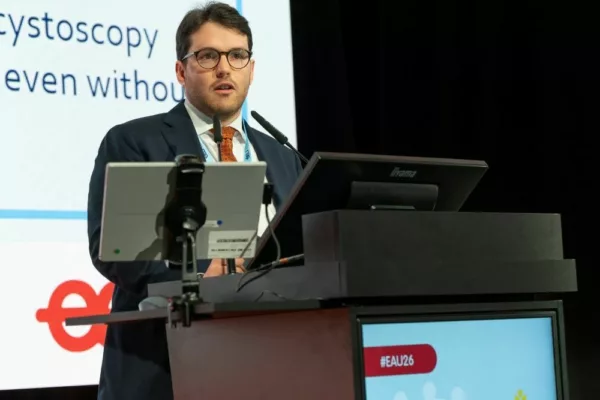
He went on to outline several factors to support this approach. Transurethral resection of bladder tumour (TURBT) carries non-trivial morbidity in ageing populations as it is not a complication-free procedure (5.1% complication rate at 30-day post-operative), with anaesthesia-related events and urinary tract infections being notable concerns in elderly and frail patients. NMIBC is also expensive, with costs amplified by frequent recurrences and overuse of surveillance in low-risk disease contributing significantly. Finally, urologists can identify LG recurrences, with an 85% accuracy in predicting LG, even without urinary cytology.
BCG-unresponsive NMIBC
In her presentation ‘How do cystectomy and bladder-sparing compare when we ask patients’, Assoc. Prof. Kathryn Gessner (US) discussed the CISTO trial (Comparison of intravesical therapy and surgery as treatment options), published last year, which was designed to compare health-related quality of life (QoL) and clinical outcomes in patients with recurrent high-grade NMIBC. The study results indicated that radical cystectomy remains an important treatment option for recurrent high-grade NMIBC. At 12 months, physical function was similar between bladder-sparing, and cystectomy, but secondary outcomes (global health, anxiety, depression, and financial wellbeing) favoured cystectomy.
“The value is always in the eyes of the beholder. What is worthless to one person may be very important to someone else”, noted Dr. Sarah Psutka (US) as she delivered the take-home messages from the discussion on BCG-unresponsive NMIBC, where experts debated bladder-sparing versus cystectomy. She emphasised that in 2026 clinicians have an exciting and ever-expanding toolbox to offer patients with high-risk BCG-unresponsive NMIBC, giving them more opportunities to seek their personal success. However, she also stressed that significant knowledge gaps remain and many questions still need to be answered.
According to Dr. Psutka, important uncertainties include how many cycles of bladder-sparing therapy (BST) are safe – balancing oncological outcomes and bladder function. “We need tools (biomarkers) to guide treatment selection, sequency, escalation and de-escalation. We need to characterise patient experience in trials and real-world practice, including treatment burden, cost and quality of life. And we need to optimise shared-decision making in this increasingly complex space to guide priority-aligned decision making.”
MIBC: A strategy for bladder-sparing
“Every single step matters when looking at a bladder-sparing strategy” stated Dr. Jeremy Teoh (HK) in his lecture on ‘Bladder-sparing in MIBC: The real-world evidence’. He outlined four critical components of the approach. First, a multi-parametric assessment is essential. This includes pre-operative MRI scans, maximal TURBT/modified en bloc resection of bladder tumour (ERBT), post-operative MRI scans, and biomarkers (e.g. PD-L1 CPS, DDR/RB1-GA, ctDNA). Secondly, patient selection depends on minimal residual disease/pCR (pathological complete response)/Pt0 disease. These individuals may be suitable for bladder-sparing therapy. Conversely, patients with gross residual disease (likely T3 or above) should proceed with neoadjuvant therapy, followed by radical cystectomy.
Thirdly, there need to be decisions on local versus systemic treatment, including mode of radiation, chemotherapy versus immune checkpoint inhibitors, or antibody-drug conjugates, as well as treatment duration. He also highlighted the potential role of using ctDNA to guide treatment decisions.
Lastly, follow-up is critical and should include longitudinal assessment with cystoscopy, cross-sectional imaging, and optimal ctDNA monitoring. The goal is to detect early signs of recurrence and intervene promptly.
In his lecture on “Who really needs surgery after neo-adjuvant chemotherapy?’, Prof. Alexandre Zlotta (CA) stated that bladder preservation is feasible, but challenging. “Up to 57% achieve pT0 (pCR) after neoadjuvant therapy, but current methods cannot readily predict who can safely avoid cystectomy or consolidation. Our prediction of pT0 is imperfect. Even the best available tests (ctDNA, MRI, genomic markers) have low sensitivity (46-59%), meaning up to 1 in 4 patients with apparent complete response (CR) may still harbour residual muscle-invasive disease.”
When discussing the future of MIBC treatment after neoadjuvant therapy, Prof. Zlotta outlined the following treatment approach:
- No local therapy for patients with a clinical CR and VI-RADS < 1, with UtDNA (urinary tumour DNA) negative or ctDNA (circulating tumour DNA) negative
- Radiation for patients with a clinical CR and VI-RADS 2, UtDNA positive or ctDNA negative
- Radiation or radical cystectomy for patients with no clinical CR, with VI-RADS 0-5, UtDNA positive or negative, and ctDNA negative
- Systemic therapy for patients who are ctDNA positive
You can watch the full webcast of this plenary session via the EAU26 Resource Centre, including debates, several case discussions.