
The Lancet-European Urology collaboration: Burden, innovation, and sustainability
Prof. Alberto Briganti (IT) and Dr. Vania Wisdom (GB) chaired today’s session “European Urology meets The Lancet: The future of urological care”, where members shared an update on The Lancet-European Urology collaborative review series. Presentations addressed global trends and the impact of benign urological conditions, long-term sustainability, and the future transformation of urological surgery.
Prof. Briganti noted that the collaborative paper is expected to be published within the next 12 months, with the hope that it will significantly contribute to advancing the field of urology, and shape future clinical practice and policy.
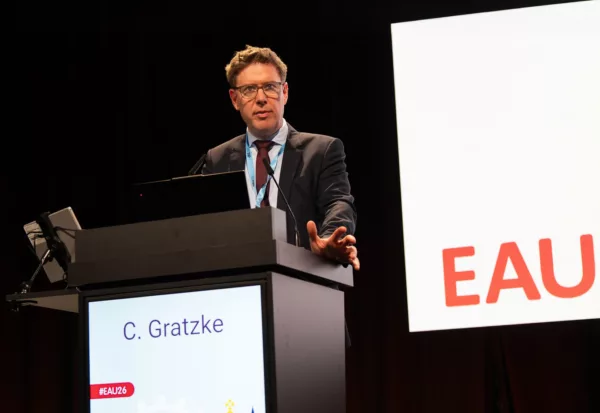
Prof. Christian Gratzke (DE) presented on the global burden of benign urological conditions as part of the collaborative insight series on epidemiology, innovation, and health equality. He emphasised that “benign does not mean harmless” as benign urological conditions place a significant drain on global health infrastructure. Although often perceived as less serious because they are not cancerous, these conditions are the primary drivers of healthcare utilisation, have a massive economic cost and systemic strain.
Prof. Gratzke also highlighted the substantial quality of life impact for patients, not only the physical symptoms but the psychological and socioeconomic impact.
- He introduced a new standard of care concept built on four-pillars:
- Advanced surgical intervention: precision, minimally invasive techniques that reduce recovery times
- Targeted pharmacotherapy: condition-specific and mitigating broad-spectrum reliance
- Lifestyle and preventive medicine: holistic patient management, diet and risk-reduction strategies
- Digital health and telecommunication: to bridge the access gap and expand specialist reach to rural and underserved areas
Prof. Gratzke stated that “digital interventions drastically reduce symptom severity, hence digital therapeutics offer a highly scalable, low-cost intervention capable of bypassing traditional clinical choke points”.
Finally, he outlines a “Framework for System Action”:
- Global education campaigns designed to eliminate stigma and drive early clinical diagnosis
- Dedicated infrastructural initiatives to improve urological care pathways in rural and historically underserved areas
- Coordinating antimicrobial (MR) stewardship globally
- Sustained, protected funding for policy initiatives for localised research and the deployment of affordable treatment options
Prof. James N’Dow (GB) presented “Ensuring long-term sustainability in urological care” noting that an added challenge is the wide variation in how sustainability is defined and understood, hence goals vary. He outlined an agenda that includes integrating sustainability into the Guidelines, conducting life-cycle assessments for major urological devices, de-escalating low-value care pathways, improving global access to high-value interventions, and importantly, training the next generation of urologists in sustainable competencies, something he remarked was absent from his own training.
Prof. James Catto (GB) presented “Transformation in urological surgery: innovations and advances”. He firstly introduced the team that were working on the paper, noting that they were not all urologists, which was very important for the review. Their priorities for the future were on sustainability and re-designing surgery, such as robotics, telesurgery and digital surgery, as well as making better patient selection. This also included the incorporation of AI if it is safe, secure, and benefits the patient. These factors also included the affordability of future healthcare needs. He noted that the global population is changing and this needs to be addressed.
You can watch the full webcast of this session which includes an interesting discussion, via the EAU26 Resource Centre.