
The price of elite performance: Strategies and recovery after adverse events
During the second half of Thematic Session “Talkshow: Physicians’ well-being and sustainable performance – joint session with the Young Urologists Office” led by Dr. Carmen Mir Maresma (ES), Dr. Philip Pierorazio (US) with Dr. Juan Luis Vásquez (DK) as the host, the audience were asked when was the last time they experienced a complication or an adverse patient outcome, majority replied within the last six months.
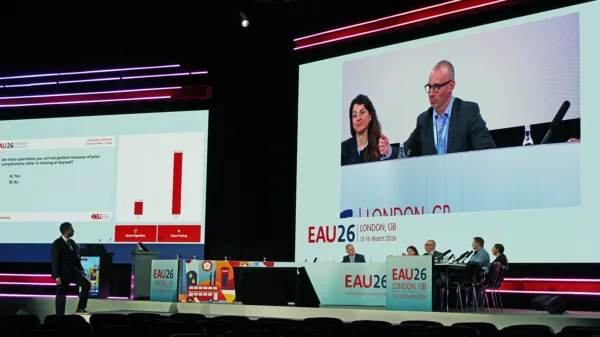
“Everyone who has worked in healthcare knows that things go wrong in healthcare. That’s a given,” stated Mr. Kevin James Turner (GB), who led the “Beyond the OR: Emotional management of surgical and non-surgical complications” discussion with Dr. Philip Pierorazio (US). The discussion focused on the strategies for emotional regulation and recovery after adverse events.
About Big Joe
Dr. Pierorazio talked about his patient, “Big Joe”. Dr. Pierorazio recalled, “He was a 29-year-old patient who had germ-cell tumour. In addition to multiple comorbidities, Joe also came from a family of morbidly obese parents. He was almost 600 lbs when I met him. He had stage 2 disease, got chemotherapy, and had an incomplete resection that RPLND showed viable germ-cell tumour despite adequate chemotherapy of four cycles of BEP, so he got more chemotherapy. His residual perineal disease continued to grow so we had another conversation about surgery again. Big Joe had major vascular reconstruction. The surgery took 9 hours. Because of his size, he went to the ICU intubated. Over the course of the next few days, Joe kept absorbing fluids that at some point, it became incompatible with life; his lungs could not oxygenate his body. Joe passed away.
“The reason why this is so poignant to me is that the indication was accurate. We did the correct surgery. He actually ended up having a primitive neuroectodermal tumour; he did not have a great prognosis but if we didn’t do surgery that day, Joe wouldn’t have died that week. These are the stories that still live with me. It hurt and it still hurts. My residents learned from it, the surgeons, the people in the operating room, and his family, everybody was affected by this major event. It still continues to impact me and affects how I make decisions about future patients.”
How to deal
Dr. Pierorazio emphasised the importance of being present for families, recognising the risks, and expressing gratitude for the care provided. He reflected that complications affect more than just the patient and staff, and stressed the value of daily conversations with residents when difficult cases arise. He highlighted engaging the operating room team, sharing what happened and why, so they have space to process. He noted that the hospital supports both formal and informal discussions around complications.
The price of elite performance
“Being a surgeon is harmful to surgeons. The evidence for that is beyond any dispute. There are increased risks of psychological comorbidity, physical symptoms, and addictive behaviours, purely from being exposed to adverse events. We as a profession have spectacularly failed to recognise that,” said Mr. Turner, who referenced the quote, “The profession that demands elite performance has devoted so little to the well-being of its practitioners, particularly its trainees.”
Fear of performing
The audience were asked “Are there operations you will not perform because of prior complications either in training or beyond?” Majority replied "No." Dr. Pierorazio shared an AUA survey which showed otherwise; 25% of urologists will not perform a surgery in their career that they experienced an adverse event as a resident in training.
Inquiry from the crowd
The audience asked how to cope with sudden, unexpected events. They noted that such events impact both the individual and their team significantly. They observed that family reactions play a critical role in coping; some families accept the situation, while others refuse to. Additionally, they highlighted the tendency to feel isolated within the institution, where colleagues and administrators may begin assigning blame.
Dr. Pierorazio underscored the importance of open communication. “The minute an adverse event happens, I give my patients my mobile number so they can reach out to me for their concerns,” he shared.
With regard to the matters on isolation, Mr. Turner said, “Fundamentally we are herd animals. It’s key in our surgical identity that we are part of the surgical herd. If you have an adverse event, you are isolated from the herd. Hospitals are complicit in that isolation, and that isolation which is unhelpful and nearly always unnecessary. The most helpful rehabilitating thing is to get you back in the herd.”
Thoughts on resilience
When asked if they believe resilience can be trained, majority of audience responded, "Yes".
The panel shared the following key strategies on resilience:
- Understand your physiological needs and the physiology of emotions
- In the aftermath of an adverse event, separate what is an appropriate focus on the surgeon’s well-being and what is an appropriate focus on the statutory and regulatory matters.
- Practice being in stressful events. An example is challenging the body to withstand stress through exercise.
- Process together as a group and hold that sense of belonging, as well as have a “wolf pack”/support group.
Watch the full discussion here to know more about the important insights shared and eye-opening questions from the floor.