
Urology Beyond Europe sessions: Bringing the world of urology to London
With the wide adoption and maturity of surgical robots, there are several innovations happening in China that show how platforms are becoming more specialised and even trained to become autonomous.
This was one of the conclusions from the Joint Session of the EAU and the World Chinese Urologists held on the morning of the opening day of the 41st Annual EAU Congress in London.
Every Annual EAU Congress features Urology Beyond Europe (UBE) sessions on the first day, in which urological societies from Asia, Africa, the Americas and Australasia have their own sessions, joined by urologists and other experts representing the EAU. The topics vary wildly across the 14 sessions, from minimally invasive surgery for urethral strictures (Maghreb Union countries) to controversies in uro-oncology (SAUS and PAUS) and always demonstrate the great diversity within the field of urology.
The EAU-World Chinese session touched on the very latest developments in urology, with AI-usage in diagnostics and innovations in robotic (tele)surgery making up the first half in a lively, quick-fire series of talks. The second half of the session addressed uro-oncology and functional and reconstructive urology. In a sense, this single two-hour session presented a microcosm of what the Annual Congress is hoping to achieve over the coming days.
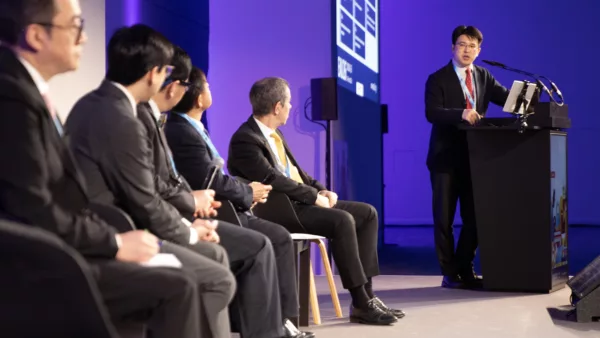
Dr. Peter Chiu (HK) shared imagery of the world’s first truly flexible in-bladder robot by Agilis Robotics. The technology looks similar to a single-port system, with two arms coming from a single sheath, but small enough to enter the bladder trans-urethrally. Dr. Chiu showed the results of the first feasibility and safety trial showing successful en-bloc resection in 11 of 13 tumours.
Co-chairing the session and leading the discussion, Prof. Evangelos Liatsikos (GR), Chair of the European School of Urology asked about the potential benefit of this robot. Dr. Chiu hoped that this would make en-bloc resection feasible for more surgeons rather than experts. The system offers better control and potentially less risk of bladder perforation. Using the system for prostate applications was not feasible because the arms currently do not have the strength to lift the lobe of the prostate.
Dr. Xin Ma (CN) showed his department's first experiments with autonomous suturing of the kidney using a dual-arm system, basically replicating human actions with AI training to map out depth perception. The first tests were carried out on animals in November 2025, achieving stable single-needle autonomous surgery.
Pioneering in telesurgery
Prof. Alberto Breda (ES), EAU Robotic Urology Section Chair, complimented the assembled Chinese urologists for “leading the world in telesurgery”, saying he was honoured to be among experts in the field. He complimented China on solving not only most of the technical barriers to telesurgery, but particularly the ethical and legal issues that are delaying adoption in Europe.
“China is one of the few countries where telesurgery is regulated,” said Prof. Breda, “whereas in Europe and elsewhere a unified multi-state framework is lacking. There are currently no specific international licensing laws in every country.”
Prof. Breda introduced the EAU’s own structured policy framework for safe telesurgery and announced the start of a telesurgery working group as part of ERUS, following from experiences in China. He also gave the first results of the first European telesurgery programme happening at his department at the Puigvert Foundation in Barcelona, connected to the Canary islands, all while using Chinese-made telesurgery-ready systems. “Despite the distance of over two thousand kilometers, it is technically still the same country, making regulation more straightforward.”